GST on art sales in India: 5% on original works, plus the TCS line above ten lakh
Artfolio team · · 6 min read
Since 22 September 2025, original art in India carries 5% GST, not 12%. And since April 2025, a sale above ten lakh rupees can add a 1% TCS line. Here is the current map, with the notifications behind it.
Two changes in 2025 settled questions galleries had been guessing at for years. The September GST revision cut the rate on original works of art from 12% to 5%. And from April, income-tax rules made the seller responsible for collecting 1% tax at source on art priced above ten lakh rupees. This post is the reference we point galleries to: what rate applies to what, and where each rule comes from. It is general information, not tax advice — your accountant owns your return.
Original works of art: 5% GST since 22 September 2025
Chapter 97 of the customs tariff covers works of art, collectors' pieces and antiques. Notification 9/2025-Central Tax (Rate) moved the whole chapter into the 5% schedule with effect from 22 September 2025:
- 9701 — paintings, drawings and pastels executed entirely by hand, collages and mosaics.
- 9702 — original engravings, prints and lithographs.
- 9703 — original sculptures and statuary, in any material.
- 9705 — collections and collectors' pieces.
- 9706 — antiques over a hundred years old.
Before that date these lines sat at 12%. If you are looking at an older invoice or an older article that says 12%, that is why.
The split: 2.5 + 2.5, or 5 as IGST
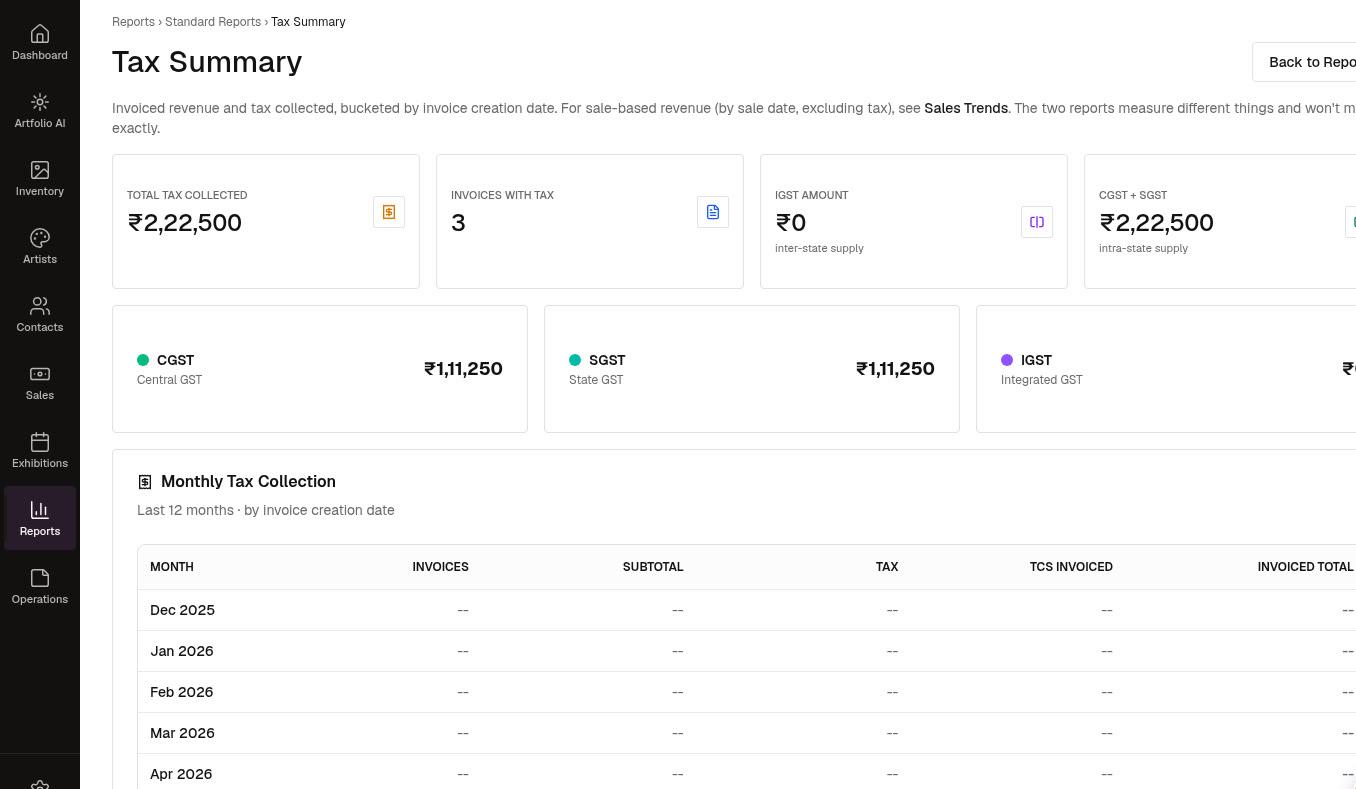
Within your own state the 5% arrives as CGST 2.5% plus SGST 2.5%. On an interstate sale it is IGST at 5%. For an ordinary sale, the place of supply is the state the work is delivered to, and that decides which of the two applies. The total is the same, the breakdown is not, and the document has to show the right one. (Our invoicing post walks through how the split, per-line rates and multi-GSTIN branding work in practice.)
Place of supply has its exceptions. In a bill-to/ship-to arrangement, where a buyer has the work delivered to someone else, section 10(1)(b) of the IGST Act treats the buyer's principal place of business as the place of supply, not the delivery address. Agents, imports and exports follow their own rules. When a sale is not a simple delivery to the buyer's address, confirm the place of supply with your accountant.
One caution: the 5% rate is for the art. Framing, crating and shipping on the same invoice are not automatically rated on their own. Where they are naturally bundled with the sale and supplied as a single package, GST treats the whole as a composite supply charged at the rate of the principal supply, the art. Where they are genuinely independent supplies, each carries its own treatment. And where independent items are packaged together for a single price without being naturally bundled, the package is a mixed supply charged at the highest rate among them. Itemising the lines on the invoice does not by itself establish separate treatment, so when an invoice mixes art with services, confirm the treatment with your accountant.
Above ten lakh: the 1% TCS line
From 22 April 2025, section 206C(1F) of the Income-tax Act reaches beyond motor vehicles. Notification 36/2025 (S.O. 1825(E)) lists ten luxury goods on which the seller collects 1% tax at source when the sale consideration exceeds ten lakh rupees — and the list expressly includes antiques, paintings, sculptures and other works of art, and collectibles such as coins and stamps.
- Who collects: the seller — the gallery or dealer — adds 1% TCS to the invoice and deposits it.
- When it applies: when the value of a single notified item crosses ten lakh rupees. The seller collects 1% on the full sale consideration at the time of receiving it, not only on the amount above ten lakh.
- What it means for the buyer: the TCS they pay is a prepaid tax — it shows up in their Form 26AS/AIS and is adjusted against their income-tax liability.
TCS is income tax, not GST, and it sits on top of the 5% GST, not instead of it. A twelve-lakh painting is a covered transaction: it carries 5% GST and 1% TCS on the full consideration, as two separate lines with two separate destinations.
On the invoice, in Artfolio
Artfolio's GST invoicing is built for exactly this map: each invoice carries the CGST/SGST or IGST split with its own rate per line, TCS is tracked where the sale crosses the threshold, and a tax summary report is ready for your accountant at filing time.
Rates and notifications in this post were checked on 19 November 2026 against the primary sources: the Press Information Bureau release on the GST rate changes (Notification 9/2025-Central Tax (Rate)), the Gazette of India (Notification 36/2025, 22 April 2025), the Income Tax Department's TCS rates page, and the CBIC's GST FAQ on composite and mixed supply. If any of these change, the numbers here change with them.
Related post: GST for galleries, without the spreadsheet