
Viewing rooms that actually sell
Artfolio · 6 min read
A viewing room is a sales tool disguised as a web page. The galleries that close from them treat them that way — curating tightly, pricing deliberately, watching who looks, and following up while the interest is still warm.
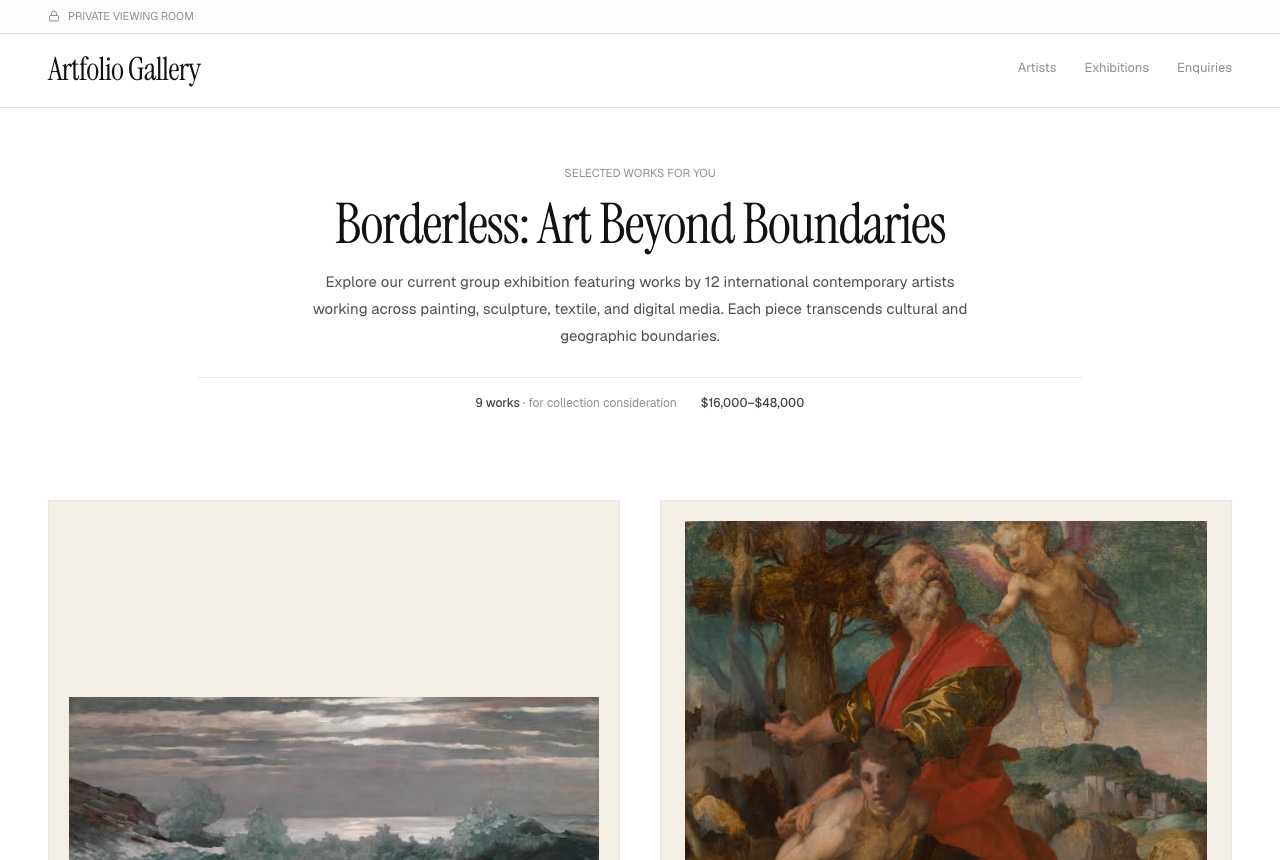
The online viewing room went from novelty to expectation in the space of a few years. Almost every gallery has one now. Far fewer use it as anything more than a glorified PDF — a link you send and then forget. The gap between those two postures is where the sales are.
A viewing room that sells isn't about flashier design. It's about treating the page as the front half of a conversation: choosing what the client sees, deciding what the price says, learning what they actually looked at, and reaching back out before the moment passes. Every one of those is a deliberate choice, and a good tool makes each of them easy.
Curate like it's a private showing
The instinct to put everything available in the room is the first mistake. A wall of forty works isn't a viewing room; it's a catalogue, and catalogues don't create urgency. A tight selection of six to ten pieces, chosen for a specific person, reads as what it is — a private showing assembled with them in mind.
In Artfolio, building that selection is a few clicks from inventory you already maintain, and you control exactly which fields each visitor sees — title, artist, medium, dimensions, and whether a price shows at all. Curation isn't an afterthought you bolt on; it's the first decision you make.
Price on purpose, including “on request”
How you present price in a viewing room is a strategy, not a setting you ignore. Sometimes a clear number does the work. Sometimes price on request is the right move — for a marquee piece, a sensitive relationship, or a market where you want the conversation to open before the figure does.
Artfolio lets you set the approach per room and per work:
- A pricing strategy for the room — show retail, or present in a specific set of display currencies for an international client.
- Per-work overrides — a room-specific price, or hiding the price on one piece while showing it on the rest.
- A clean “price on request” state that turns a hidden number into an invitation to talk rather than a dead end.
The goal is that the price never accidentally undercuts the pitch. It should always be saying exactly what you want it to say to this person.
Watch the room, then act on it
This is the part most galleries are flying blind on. When you send a PDF, you learn nothing. When you send a viewing room with per-visitor analytics, you learn almost everything that matters: who opened it, which works held their attention, what they came back to, and how long they stayed.
That signal changes the follow-up entirely. Instead of a generic “did you have a chance to look?”, you can open with the piece they actually lingered on. A collector who returned three times to the same canvas is not the same lead as one who glanced once and left — and now you can tell the difference and treat them differently.
The follow-up is the close
Interest decays. A viewing room that generated real engagement on Tuesday is a cold link by the following Monday if nobody reaches out. The galleries that convert are simply the ones that follow up fast and specifically, while the work is still on the client's mind.
Because the room lives in the same workspace as the rest of Artfolio, the next step is right there: an AI-drafted email or WhatsApp message that already knows the works in the room and the client's engagement, ready for you to make personal and send. When the answer is yes, the path from interest to offer to invoice is one continuous flow, not a hand-off to another tool.
Treat the viewing room as a sales conversation rather than a brochure — curate it for one person, price it on purpose, read what the analytics tell you, and follow up while it's warm — and it stops being a link you hope lands. It becomes the most reliable closing tool the gallery owns.
See it on your own collection
Start a 30-day free trial — no credit card.