
Running an art-fair booth from your phone
Artfolio · 6 min read
An art fair is the most concentrated selling environment a gallery faces all year — and the worst possible place to be tethered to a laptop and a printer. The booth that closes is the one that runs from the device already in your hand.
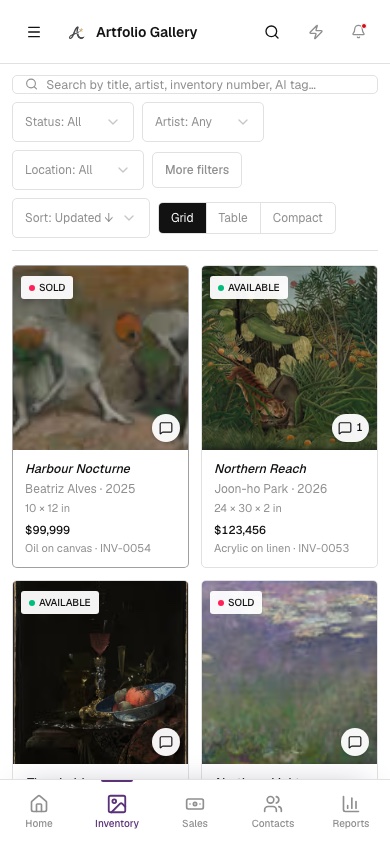
Opening night at a fair is a particular kind of intensity. A collector you've courted for months is standing in front of a work, ready. A curator wants the price list for three pieces, now. Someone's asking whether the red one is still available while you're mid-conversation with someone else. The energy is exactly what you came for — and it evaporates the moment you have to say “let me go check on the laptop.”
The booth that wins isn't the one with the most staff or the biggest works. It's the one where every answer is instant and every yes can be closed on the spot, because the whole gallery is accessible from a phone. Mobile-first isn't a nice-to-have at a fair — it's the difference between catching a sale and watching it cool.
The whole inventory in your pocket
The most basic failure at a booth is not being able to answer a question about your own work. Is it available? What's the price? What's the medium, the year, the dimensions? Has it sold in the last hour? On a laptop in the back, those answers cost you the moment. On a phone, they cost you nothing.
Artfolio is built to be worked from a phone, so your full inventory — current status included — is a glance away while you're standing in the booth. When a collector points at a canvas, you already know whether it's yours to sell, and you never break eye contact to find out.
Floor sheets and price lists on demand
Fairs run on documents, and the gallery that can produce the right one instantly looks like the gallery that has its act together. The two that matter most are the floor sheet and the price list, and both should be a tap away — not something you printed last night and have run out of.
- Floor sheets — the booth's checklist of works, generated from the inventory you already maintain, ready to share or print.
- Price lists — clean, current, and correct, so the curator asking for three prices gets them in seconds, not after a hunt.
- Catalogue PDFs — a polished leave-behind for the serious collector who wants to take the booth home with them.
Because these come straight out of live inventory, they're never stale. A work that sold this morning isn't still sitting on the price list you hand over this afternoon.
Close it on opening night
Here is where mobile-first pays for itself entirely. A collector says yes. At most galleries, that yes triggers a process: note it down, sort the paperwork back at the gallery, send an invoice next week. Every step between the yes and the invoice is a chance for the moment — and sometimes the sale — to slip.
From a phone in the booth, you can raise the invoice on the spot. The work, the price, the buyer, the correct tax treatment — GST handled properly, the right branding theme for the selling location, a UPI QR for instant payment. The collector leaves the fair already invoiced, the work's status flips to sold so nobody offers it twice, and you're back to the floor without missing the next conversation.
The booth stays calm because the system does the carrying
The quiet benefit of running the booth from one mobile workspace is that nothing has to be reconciled later. The sale that happened at 7:40pm updated the inventory, the collector's history, and the pipeline the instant it closed. There's no shoebox of scribbled notes to decode on Monday, no “wait, did we already invoice that one?”, no mismatch between what sold and what the records say sold.
An art fair will always be intense — that's the point of it. What it doesn't have to be is chaotic. When the whole gallery runs from the phone in your hand — inventory, documents, invoicing, all live and all connected — the booth becomes a place where you sell with confidence instead of scrambling to keep up. The energy stays on the floor, where it belongs, and the admin takes care of itself.
See it on your own collection
Start a 30-day free trial — no credit card.