
Why AI belongs in the gallery back office
Artfolio · 6 min read
Most galleries don't need AI to write their wall texts or price their masterpieces. They need it to absorb the hours of typing, tagging, and chasing that nobody enjoys and nobody bills for.
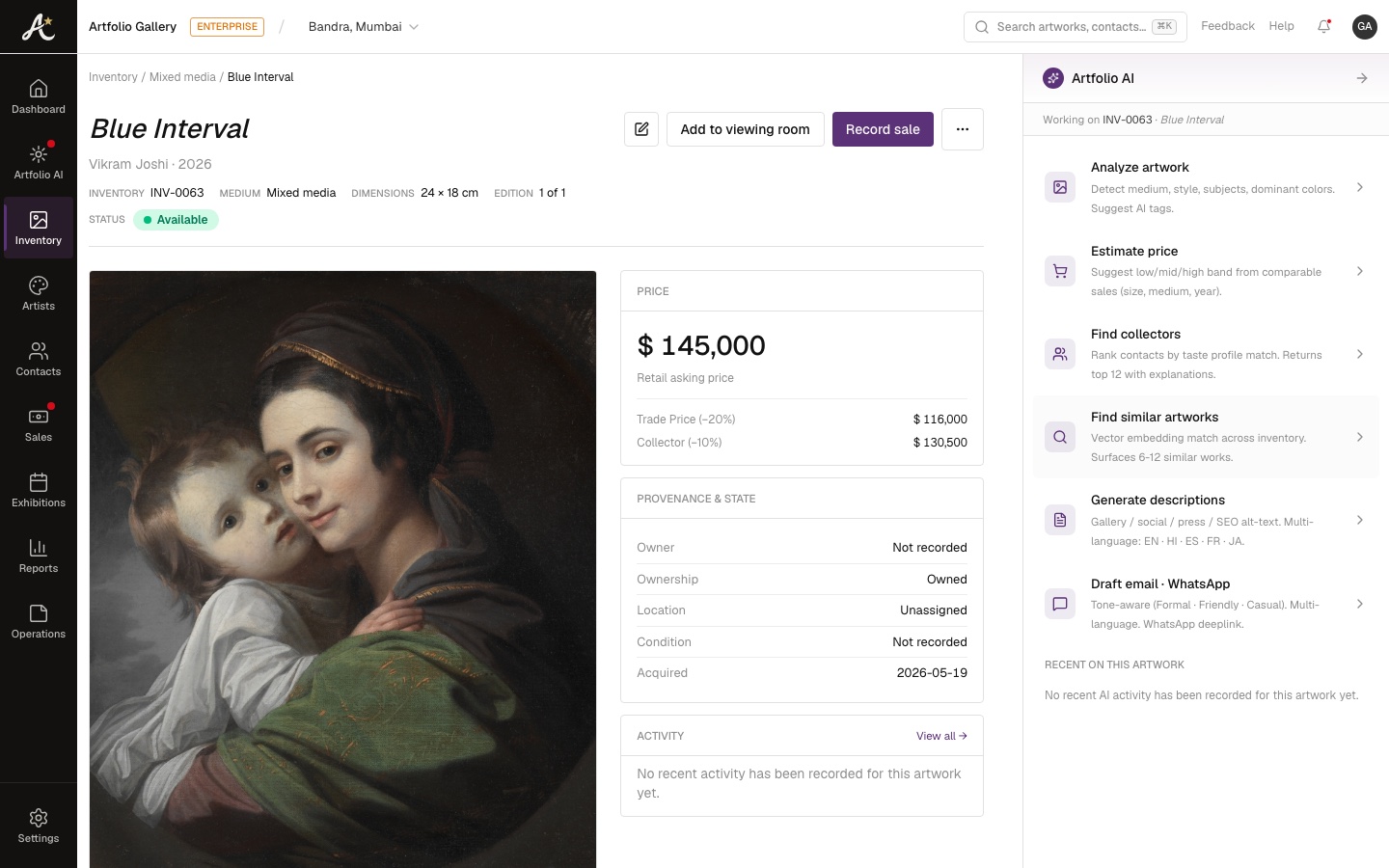
Walk into almost any gallery back office and you'll find the same scene: a registrar re-typing dimensions from a packing list, a director scrolling a contacts spreadsheet trying to remember who liked the blue ones, an assistant rewriting the same “just following up” email for the ninth time this week. None of that work is creative. All of it is necessary. And almost all of it is exactly what AI is good at.
The mistake the art world keeps making is pointing AI at the wrong jobs. It is not here to decide what a painting is worth or to invent a curator's argument. It is here to do the data entry, the matching, and the first drafts — so the people who are good at taste get their time back for taste. That is the whole case for AI in the back office, and it is a strong one.
Cataloguing is data entry, and data entry is solved
Adding a work to inventory should take seconds, not a coffee break. In Artfolio, you upload one image and the AI reads it: medium, likely style and mood, the dominant colours, a set of suggested tags, and a suggested price band drawn from comparable sales rather than a number pulled from the air. You review what it filled in, correct anything it got wrong, and move on. The record still has all 28 fields a serious gallery needs — you just didn't type most of them.
This matters most at scale. Onboarding a new artist's body of work, or migrating years of inventory off a spreadsheet, is the kind of task that gets perpetually postponed because it's so tedious. When the machine does the first pass and a human only edits, a backlog that used to feel like a month of evenings becomes a weekend.
The matching nobody has time to do by hand
Every gallery sits on a quiet goldmine: a contact list of people who have already bought, enquired, or lingered. The problem is human memory doesn't scale past a few hundred relationships, and the spreadsheet version can't reason about taste. AI can.
Where it earns its keep day to day:
- Collector matching — given a new work, surface the handful of contacts whose history and interests actually fit, instead of blasting the whole list.
- Similar-artwork search — find the pieces in your own inventory that rhyme with one a client just admired.
- A daily inbox of suggestions — lapsed collectors worth a note, inventory that's gone stale, an exhibition that needs prep — surfaced before you'd have thought to look, with a predictable monthly cost cap so the bill never surprises you.
None of this replaces a salesperson's instinct. It replaces the scrolling that happens before the instinct kicks in.
First drafts, not final words
The follow-up email is the single most-skipped step in gallery sales, and it's skipped because of friction, not laziness. Artfolio drafts it for you — an email or a WhatsApp message, in English, Hindi, Spanish or French — already aware of the work, the price, and the relationship. You read it, make it sound like you, and send. The blank page is gone; your voice is still there.
That distinction — first draft versus final word — is the line that keeps AI honest. A draft you approve is a tool. A message that goes out unread is a liability.
Where the human must stay in the loop
Being clear-eyed about what AI shouldn't do is what makes it safe to lean on for everything else. A few jobs belong to people, permanently:
- The final price. A band from comparable sales is a starting point. The number you commit to reflects condition, provenance, the moment, and the relationship — and that's a judgement call.
- The relationship itself. AI can tell you who to call. It cannot be the gallery to that collector.
- Anything that goes out under your name. Every draft gets a human read before it's sent. No exceptions.
Keep AI on the busywork and a human on the taste, and you get the best of both: a back office that runs itself and a front of house that's finally free to do the part only people can. That's not a far-off promise — it's on every screen in Artfolio today, included in every plan. The galleries that win the next decade won't be the ones with the most staff. They'll be the ones whose staff spend their hours on the things that actually need a person.
See it on your own collection
Start a 30-day free trial — no credit card.