
From five tools to one workspace
Artfolio · 6 min read
No gallery set out to run on five disconnected tools. It happened one reasonable decision at a time. The trouble is that the seams between those tools are where the work — and the mistakes — quietly pile up.
Ask a gallery how it keeps track of things and you'll usually get a list, not an answer. Inventory in a spreadsheet. Mailing in Mailchimp. Images and contracts in Dropbox. Day-to-day coordination in a WhatsApp group. Invoices in Word or a second spreadsheet. Each was a sensible choice on the day it was made. Together, they've become a system nobody designed and nobody fully controls.
The cost of this isn't the monthly subscriptions. It's the invisible tax paid at every boundary between tools — the re-typing, the version confusion, the “which one is current?” — and the fact that no single place can tell you the truth about your own gallery. That's the problem one connected workspace actually solves.
The spreadsheet that became the gallery's brain
The inventory spreadsheet starts innocent and ends up load-bearing. It holds the artworks, then the prices, then a column for status, then a tab for sales, then a tab someone uses for consignments. Eventually the whole business depends on a file that one person understands and nobody dares restructure.
Spreadsheets are brilliant at arithmetic and terrible at being a system of record. They don't enforce a status, can't hold an image, won't stop two people overwriting each other, and have no idea that the row they just deleted was a work currently on loan. Proper inventory — structured records, defined statuses, named views by role, documents attached to the work itself — is what a spreadsheet has been pretending to be all along.
Four seams where the work hides
The pain of tool sprawl isn't inside any one tool. It's in the gaps between them, where information has to be carried by hand:
- Spreadsheet → mailing tool. You can't email the right collectors about a new work without exporting, cleaning, and re-importing a list that's stale the moment it lands.
- Dropbox → everywhere. The image and the contract live in a folder that has no idea which artwork or sale they belong to, so finding them later is an archaeology project.
- WhatsApp → memory. The decision about a price or a hold happened in a chat thread that scrolls away, leaving no record on the work or the deal.
- Invoice → reality. The invoice in Word doesn't know the work is now sold, doesn't update the contact's history, and doesn't move the sale forward anywhere.
Every one of these seams is a place where a number gets re-typed wrong, a file goes missing, or two people end up with different versions of the truth.
What “one workspace” actually means
Consolidation isn't about having fewer logins for their own sake. It's about the work flowing without anyone carrying it across a boundary by hand. In Artfolio, the connections are the point:
- The contact who bought a work carries the engagement timeline, the interest tags, and the VIP tier — so “who likes the blue ones” is a filter, not a memory.
- The artwork carries its own images, documents, location, and condition history in a folder-per-entity vault — no more hunting Dropbox.
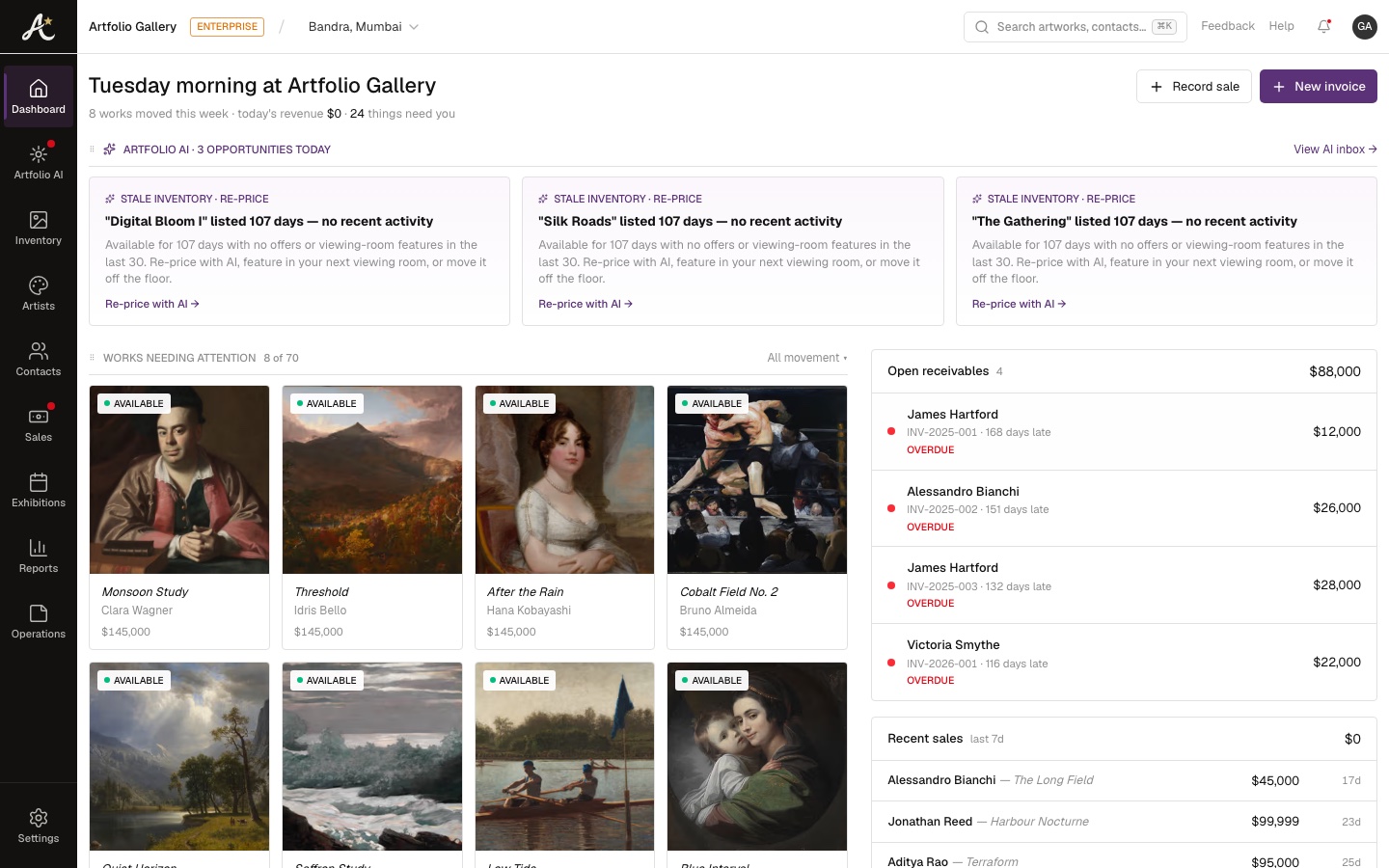
- The sale runs offer → proforma → invoice in one flow, updating the work's status and the collector's history as it goes.
- The AI sits on top of all of it, drafting the email to the right collector because it can see the same connected data you can.
The dashboard you couldn't have before
Here's the quiet payoff of one workspace: you can finally ask your gallery a question and get an answer. What's sold this month, what's still in the pipeline, which works have gone stale, which collectors have gone quiet. None of that is answerable when the data is scattered across five tools that don't talk. All of it is a glance away when it's in one place.
Going from five tools to one isn't a tidy-up exercise — it's the difference between a gallery that's held together by one person's diligence and one that's held together by its software. The five tools each solved a problem and quietly created three. The workspace solves the problem they were actually all part of, and does it for less than the stack it replaces.
See it on your own collection
Start a 30-day free trial — no credit card.