
A registrar's guide to clean inventory
Artfolio · 7 min read
Clean inventory isn't a tidy spreadsheet — it's a record you can trust under pressure, when an insurer, a courier, or a collector's lawyer asks a question and the answer has to be right the first time.
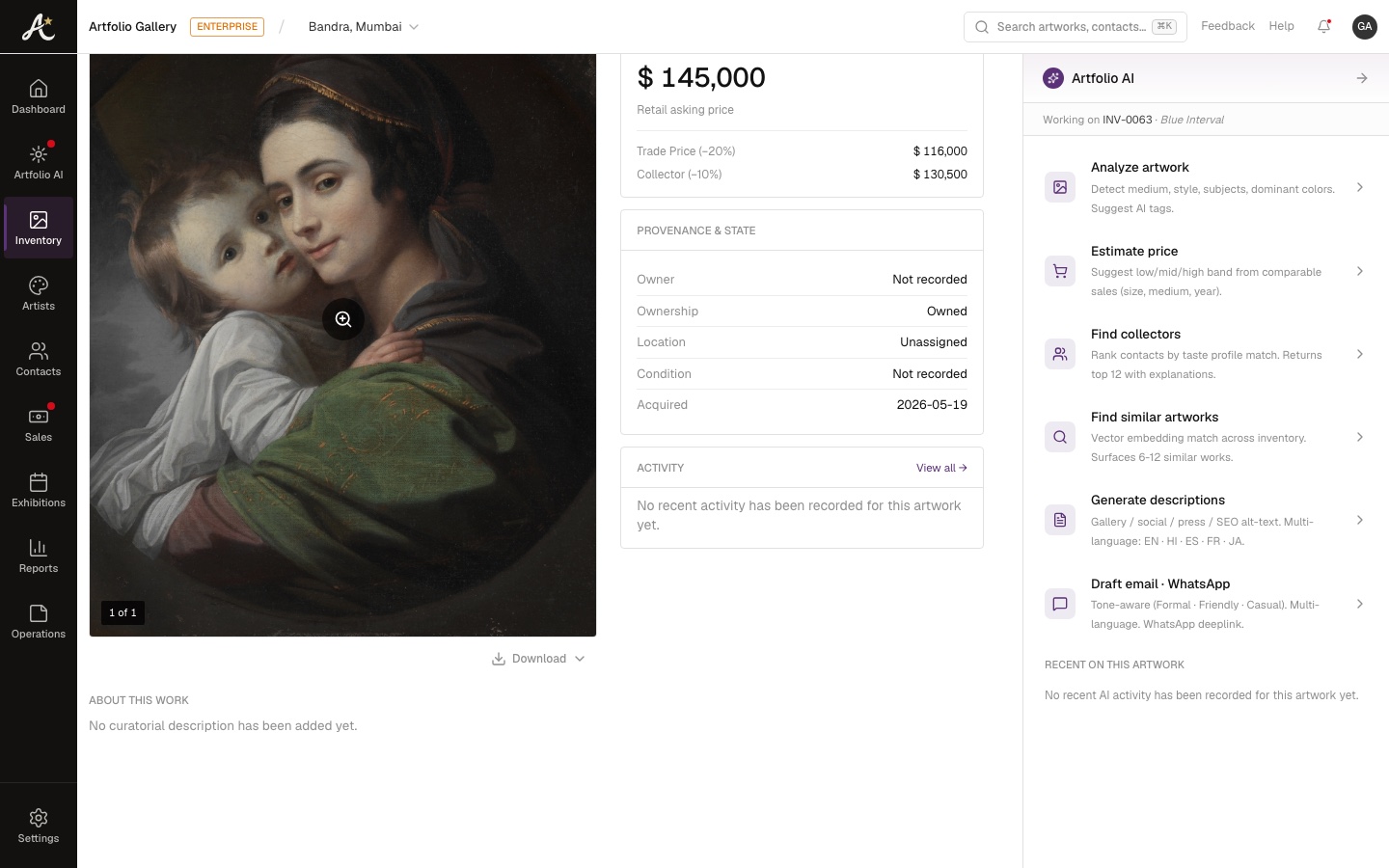
Registrars are the people who find out, at the worst possible moment, whether a gallery's inventory is actually clean. The loan request that needs a condition report. The insurance claim that needs a value and a provenance. The fair shipment that needs to know exactly which crate holds which work. When the records are good, these are five-minute tasks. When they're not, they're a frantic afternoon of reconstruction.
Clean inventory is a discipline, not a one-time clean-up. It's built from a handful of habits applied consistently: capturing the fields that matter, giving each role the view it needs, keeping documents with the works they belong to, knowing where everything physically is, and never letting condition or provenance go undocumented. Here's the working version of each.
The fields that earn their place
A work has a lot of possible attributes, and the temptation is to either capture too few (and regret it later) or demand too many (and let the record rot half-empty). Artfolio's artwork record carries the 28 fields a serious gallery actually uses — and the discipline is knowing which ones are non-negotiable.
- Identity — title, artist, year, medium, dimensions, and a unique inventory number. Without these you don't have a record, you have a note.
- Status and ownership — available, sold, reserved, on loan, on consignment — and whether you own it or hold it. This is what stops a sold work being offered twice.
- Value and insurance — the figures an insurer and an accountant will ask for, kept current rather than guessed at claim time.
Named views so everyone sees the right thing
The mistake is thinking everyone needs the same view of inventory. A registrar wants locations and condition. A salesperson wants prices and availability. At a fair you want a stripped-down sheet with nothing confidential on it. Forcing all of them through one layout means everyone wades past columns they don't need.
Named views solve this: each role saves the columns, sorting, and filters that suit its work, and switches to it in a click. Smart collections extend the idea — define a rule once (“everything on loan”, “works needing a condition check”) and the set maintains itself. The inventory is one source of truth; the views are how each person reads it without tripping over everyone else's needs.
A document vault, not a Dropbox folder
The condition report, the certificate of authenticity, the provenance documentation, the loan agreement — these aren't loose files. They belong to a specific work, and they need to be there when the work's record is open, not hunted down in a folder named after a date.
Artfolio gives every entity its own document vault — a folder-per-work, per-contact, per-exhibition — so the paperwork lives with the thing it describes. When a loan request lands, the condition history and the agreement are one click from the artwork, not one archaeology dig from your memory.
Know where every work physically is
Inventory that's accurate on value but vague on location is only half clean. The registrar's recurring nightmare — “we know we have it, we just can't find it” — is a location problem, and it's eminently solvable.
- Two-level locations — a gallery and the specific room, rack, or crate within it — so “in storage” becomes “in storage, rack 3”.
- Avery QR labels printed straight from inventory, so a scan on a crate pulls up the work it holds.
- An in-situ wall preview — the work shown to scale against a 300cm wall with a 170cm silhouette — for the install conversation before anything moves.
Condition and provenance, documented as you go
The discipline that separates clean inventory from the rest is this: you document condition and provenance when they change, not when someone demands them. A condition note made the day a work returns from a fair is worth ten reconstructed under pressure for a claim. Provenance captured at acquisition is solid; provenance recalled years later is a liability.
Build these into the routine — every movement gets a condition check, every acquisition gets its provenance recorded — and the inventory stays trustworthy by default. Clean inventory, in the end, isn't about how neat it looks on a quiet day. It's about whether it holds up on the worst one. Get the fields, the views, the vault, the locations, and the documentation habits right, and it always will — which is exactly the point of running it in one system instead of five.
See it on your own collection
Start a 30-day free trial — no credit card.